The late EDWARD GREENFIELD on view:
23 February 2016


18 May 2015
* * * * * Seid umschlungen, Millionen! * * * * *
Introducing a new website, mostly about classical music, compiled by Richard Buell (who also operates Ear Trumpet, The Air This Week, and euthymia)
Where I live: here and here.
10 October 2012
WHO publishes the best, most useful [but not infallible -- Ed.] listings -- who, what, when, where -- of classical music concerts in Boston and environs?

They can be found here.
They can be found here.
* * * * * * * * * ARNOLD SCHOENBERG * * * * * * * * *
+ Los Angeles, 1934: Schoenberg conducts Mahler on the radio
16 January 2012

"She's a delight -- I never came across her before. What piano fingers, never mind the (so bizarre) voice!" -- Paul Driver, The Sunday Times (London).
A video clip: here.
10 June 2010
HOW TO WRITE MUSIC CRITICISM
Weill, Kurt. Die Dreigroschenoper.
Trude Hesterberg, Mrs. Peachum; Johanna von Koczian, Polly Peachum; Inge Wolffberg, Lucy Brown; Lotte Lenya, Jenny; Willy Trenk-Trebitsch, Mr. Peachum; Erich Schellow, Macheath; Wolfgang Grunert, Tiger Brown; Wolfgang Neuss, Street Singer; Kurt Hellwig, Paul Otto Kuster, Josef Hausmann, Martin Hoeppner, 4 Gangsters.
Guenther Arndt Chorus, Sender Freies Berlin Orchestra, Wilhelm Brueckner-Rueggerberg, conductor. * COLUMBIA O2L 257. Two LP.
Not many years ago it would have been necessary to explain at length the history of The Threepenny Opera and its creators. Weill had, of course, become well known as the composer of several successful Broadway shows, but few in this country knew that Bert Brecht was the most interesting German playwright of his generation. Now, as I write, Marc Blitzstein's version of The Threepenny Opera has been running for well into four years at the off-Broadway Theatre de Lys, and the stature of this Brecht-Weill collaboration is no longer a fancy in the minds of a few intellectuals and a handful of German refugees. We have here one of the few masterpieces of our time, and we have it in a wonderful recording.
For Brecht and Weill, the two-hundredth anniversary in 1928 of the original Beggar's Opera provided both the perfect occasion and the perfect vehicle for their social and artistic ideal. Using the characters and the situations of John Gay's opera, introducing (in the German translation of K.L. Ammer) some of Francois Villon's verses, all transfigured by his own very special mastery of German, Brecht created an unforgettable stage image of the world as he unflinchingly saw it. Weill was the perfect partner. The text setting is such that Brecht's shark-toothed lines and Weill's memorable tunes are completely inseparable. The music seems almost shockingly simple, cleaner than the music-hall songs from which its main features are derived, much less complex rhythmically than the jazz from which some of its textures and sonorities are taken. The general effect is of the most fastidiously calculated vulgarity. If music can sound mean and grubby, this is it; the creation of this manner to match Brecht's cynical and sentimental world is a master stroke of the imagination, the execution a landmar k of human skill.
Columbia's album, recorded in Berlin early in 1958 under the personal supervision of Weill's widow, Lotte Lenya, is complete musically, but just about all the spoken dialogue is omitted. Two numbers are included that were left out of the published score: one is Mrs. Peachum's Ballad of Sexual Dependency, which was restored for the De Lys revival; the other is a pseudo-operatic jealousy scene for Lucy, which has never been done previously. The Barbara Song is given back to Polly; but Pirate Jenny, originally placed in the first act as part of the entertainment provided by Polly at the wedding, is placed in the familiar and more effective context of the Act II whorehouse scene, where it is sung by the real Jenny. Throughout, more verses are included than is customary in the theater, though in the Moritat and the Solomon Song fewer are sung than are printed in the text of the play.
Not only does the dramatic and verbal shape vary somewhat from what is likely to be familiar to American listeners, but the whole style of performance is different. Although the tempos seemed startlingly slow, when I checked them I found that, with one exception, they were faster than the metronome marks indicate. The breadth that the work gains allows for greater declamatory force. In general the German actors seem to take the piece more seriously than their American counterparts; and the orchestra from the Berlin Radio makes sounds that hardly resemble at all the wheezings of the Lewis Ruth Band, still to be heard on the thirty-year-old Telefunken recording, nor the carefully studied approximations of these sounds that have generally been made by bands in more recent performances. Instead, the playing is fastidious and polished, and the results are most persuasive: the orchestration (itself a miracle of economical workmanship) for the bizarre little ten-man band is put into its proper perspective as a deliberately borrowed foreign element, and no attempt is made to suggest a nonexistent kinship with real jazz style.
Now, the individual performances: the senior Peachums are wonderful. Trude Hesterberg is an old hand at this sort of thing, and every note and word she produces is something to be cherished. Trenk-Trebitsch is a hard-boiled and angry "Beggar's Friend," effective and exciting, though I find he penetrates less profoundly into the role than did its creator, Erich Ponto, who can be heard on the Telefunken record. Erich Schellow, the Macheath, can hardly sing at all, but unless you insist on listening with your eyes glued to the score you won't notice this defect. His is the most rhythmic declamation of all to be heard on the records, and his grasp of the part seems ideal. I am not quite sure I understand Johanna von Koczian's reading of Polly Peachum. In her farewell to Macheath and in the Jealousy Duet she portrays to perfection Polly's sweetness and vivaciousness, but she chooses to do the Barbara Song on the edge of a leer that leaves me most uncomfortable. It may be that in a complete performance this gifted young actress could reconcile the conflicting elements of her interpretation, but on records, with only the songs to go by, I remain puzzled and unconvinced.
Lenya's performance as Jenny becomes broader with repetition, and in certain details such as the "hoppla" at the end of Pirate Jenny becomes less effective for the broadening. There is no doubt, however, that Lenya remains a great and fascinating theatrical personage. I cannot imagine her being surpassed in her impassioned treatment of the Act II finale, and her singing with Schellow of the Procurer's Ballad is of a warmth and humor that make it perhaps the greatest thing on these records. All the minor characters are fine, too, particularly Wolfgang Neuss as the Street Singer. As usual, Brueckner-Rueggerberg cannot be praised too extravagantly for his intentions and achievements.
Aside from the first two numbers following the Overture, where the voices rather swamp the accompaniment, and the Barbara Song in which Polly sounds sharply sibilant, Columbia's sound is excellent throughout. And the album is a handsome affair. There are thirty-six pages of reading matter and pictures -- of which the most useful portions are the libretto with a rather drab translation, and an excellent essay by David Drew, Weill's biographer-to-be. The album itself was designed by Ben Shahn, and as a bonus there is also a Shahn poster, "suitable for framing" as they say.
Both an M-G-M record offering a faithful and enjoyable reproduction of The Threepenny Opera as it sounded at the Theatre de Lys some years ago and the famous Telefunken record are valuable, but neither anticipates in completeness or quality the accomplishment of Columbia's brilliant new album.
-- C.M.S. [Carl Michael Steinberg], in "The Fifth High Fidelity Annual Records in Review: 1959," edited by Frances Newbury (Great Barrington MA: The Wyeth Press, 1959).
Weill, Kurt. Die Dreigroschenoper.
Trude Hesterberg, Mrs. Peachum; Johanna von Koczian, Polly Peachum; Inge Wolffberg, Lucy Brown; Lotte Lenya, Jenny; Willy Trenk-Trebitsch, Mr. Peachum; Erich Schellow, Macheath; Wolfgang Grunert, Tiger Brown; Wolfgang Neuss, Street Singer; Kurt Hellwig, Paul Otto Kuster, Josef Hausmann, Martin Hoeppner, 4 Gangsters.
Guenther Arndt Chorus, Sender Freies Berlin Orchestra, Wilhelm Brueckner-Rueggerberg, conductor. * COLUMBIA O2L 257. Two LP.
Not many years ago it would have been necessary to explain at length the history of The Threepenny Opera and its creators. Weill had, of course, become well known as the composer of several successful Broadway shows, but few in this country knew that Bert Brecht was the most interesting German playwright of his generation. Now, as I write, Marc Blitzstein's version of The Threepenny Opera has been running for well into four years at the off-Broadway Theatre de Lys, and the stature of this Brecht-Weill collaboration is no longer a fancy in the minds of a few intellectuals and a handful of German refugees. We have here one of the few masterpieces of our time, and we have it in a wonderful recording.
For Brecht and Weill, the two-hundredth anniversary in 1928 of the original Beggar's Opera provided both the perfect occasion and the perfect vehicle for their social and artistic ideal. Using the characters and the situations of John Gay's opera, introducing (in the German translation of K.L. Ammer) some of Francois Villon's verses, all transfigured by his own very special mastery of German, Brecht created an unforgettable stage image of the world as he unflinchingly saw it. Weill was the perfect partner. The text setting is such that Brecht's shark-toothed lines and Weill's memorable tunes are completely inseparable. The music seems almost shockingly simple, cleaner than the music-hall songs from which its main features are derived, much less complex rhythmically than the jazz from which some of its textures and sonorities are taken. The general effect is of the most fastidiously calculated vulgarity. If music can sound mean and grubby, this is it; the creation of this manner to match Brecht's cynical and sentimental world is a master stroke of the imagination, the execution a landmar
k of human skill.Columbia's album, recorded in Berlin early in 1958 under the personal supervision of Weill's widow, Lotte Lenya, is complete musically, but just about all the spoken dialogue is omitted. Two numbers are included that were left out of the published score: one is Mrs. Peachum's Ballad of Sexual Dependency, which was restored for the De Lys revival; the other is a pseudo-operatic jealousy scene for Lucy, which has never been done previously. The Barbara Song is given back to Polly; but Pirate Jenny, originally placed in the first act as part of the entertainment provided by Polly at the wedding, is placed in the familiar and more effective context of the Act II whorehouse scene, where it is sung by the real Jenny. Throughout, more verses are included than is customary in the theater, though in the Moritat and the Solomon Song fewer are sung than are printed in the text of the play.
Not only does the dramatic and verbal shape vary somewhat from what is likely to be familiar to American listeners, but the whole style of performance is different. Although the tempos seemed startlingly slow, when I checked them I found that, with one exception, they were faster than the metronome marks indicate. The breadth that the work gains allows for greater declamatory force. In general the German actors seem to take the piece more seriously than their American counterparts; and the orchestra from the Berlin Radio makes sounds that hardly resemble at all the wheezings of the Lewis Ruth Band, still to be heard on the thirty-year-old Telefunken recording, nor the carefully studied approximations of these sounds that have generally been made by bands in more recent performances. Instead, the playing is fastidious and polished, and the results are most persuasive: the orchestration (itself a miracle of economical workmanship) for the bizarre little ten-man band is put into its proper perspective as a deliberately borrowed foreign element, and no attempt is made to suggest a nonexistent kinship with real jazz style.
Now, the individual performances: the senior Peachums are wonderful. Trude Hesterberg is an old hand at this sort of thing, and every note and word she produces is something to be cherished. Trenk-Trebitsch is a hard-boiled and angry "Beggar's Friend," effective and exciting, though I find he penetrates less profoundly into the role than did its creator, Erich Ponto, who can be heard on the Telefunken record. Erich Schellow, the Macheath, can hardly sing at all, but unless you insist on listening with your eyes glued to the score you won't notice this defect. His is the most rhythmic declamation of all to be heard on the records, and his grasp of the part seems ideal. I am not quite sure I understand Johanna von Koczian's reading of Polly Peachum. In her farewell to Macheath and in the Jealousy Duet she portrays to perfection Polly's sweetness and vivaciousness, but she chooses to do the Barbara Song on the edge of a leer that leaves me most uncomfortable. It may be that in a complete performance this gifted young actress could reconcile the conflicting elements of her interpretation, but on records, with only the songs to go by, I remain puzzled and unconvinced.
Lenya's performance as Jenny becomes broader with repetition, and in certain details such as the "hoppla" at the end of Pirate Jenny becomes less effective for the broadening. There is no doubt, however, that Lenya remains a great and fascinating theatrical personage. I cannot imagine her being surpassed in her impassioned treatment of the Act II finale, and her singing with Schellow of the Procurer's Ballad is of a warmth and humor that make it perhaps the greatest thing on these records. All the minor characters are fine, too, particularly Wolfgang Neuss as the Street Singer. As usual, Brueckner-Rueggerberg cannot be praised too extravagantly for his intentions and achievements.
Aside from the first two numbers following the Overture, where the voices rather swamp the accompaniment, and the Barbara Song in which Polly sounds sharply sibilant, Columbia's sound is excellent throughout. And the album is a handsome affair. There are thirty-six pages of reading matter and pictures -- of which the most useful portions are the libretto with a rather drab translation, and an excellent essay by David Drew, Weill's biographer-to-be. The album itself was designed by Ben Shahn, and as a bonus there is also a Shahn poster, "suitable for framing" as they say.
Both an M-G-M record offering a faithful and enjoyable reproduction of The Threepenny Opera as it sounded at the Theatre de Lys some years ago and the famous Telefunken record are valuable, but neither anticipates in completeness or quality the accomplishment of Columbia's brilliant new album.
-- C.M.S. [Carl Michael Steinberg], in "The Fifth High Fidelity Annual Records in Review: 1959," edited by Frances Newbury (Great Barrington MA: The Wyeth Press, 1959).
09 June 2010
- - - - - - - - - - - - STEPHAN GENZ (baritone) - - - - - - - - - - - -
About: Paul Griffiths/New York Times .... Hilary Finch/BBC Music Magazine.
Audio: Schumann "Dein Angesicht" (with Claar Ter Horst, piano)
...........................................................................................................
30 March 2010

Following his conducting of the US premiere of Peter Grimes at Tanglewood in 1946 ... Bernstein and Britten were rarely in touch. As Bernstein's biographer Humphrey Burton notes, 'perhaps Britten did not warm to his flamboyant interpreter' (Leonard Bernstein, p. 153).
Prompted by Burton's description, Donald Mitchell remembers Britten telling him that, on one occasion, travelling together by cab down Fifth Avenue he became so exasperated by a show of Bernstein's undeniably flamboyant personality -- he could not remember what it was that so irritated him -- that he punched him in the chest in an effort to shut him up.
It was the only time, Britten claimed, 'that I have ever punched anybody.'
-- "Letters from a Life: Selected Letters of Benjamin Britten, Volume Three 1946-51," ed. Donald Mitchell et al.
...................................................................................................................................................................................................
18 January 2010
.......................................................................................................................
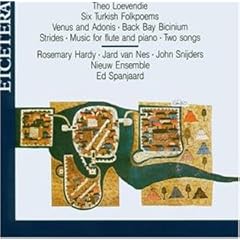
Hark! A concert by THEO LOEVENDIE and the Ensemble Ziggurat.
The particulars.
.......................................................................................................................
Hark! A concert by THEO LOEVENDIE and the Ensemble Ziggurat.
The particulars.
.......................................................................................................................
08 January 2010
From the Clippings Folder
Why have newly invented instruments hardly ever succeeded in establishing themselves in Western music?
Bayan Northcott weighs in.
.......................................................................................................................
Why have newly invented instruments hardly ever succeeded in establishing themselves in Western music?
Bayan Northcott weighs in.
.......................................................................................................................
28 December 2009
The habit of excessive indulgence in music, for those who are neither performers themselves nor musically gifted enough to take it in a purely intellectual way, has probably a relaxing effect upon the character. One becomes filled with emotions which habitually pass without prompting to any deed, and so the inertly sentimental condition is kept up. The remedy would be, never to suffer one's self to have an emotion at a concert, without expressing it afterwards in some active way. Let the expression be the least thing in the world -- speaking genially to one's aunt, or giving up one's seat in a horsecar, if nothing more heroic offers -- but let it not fail to take place.
-- "Habit," in William James, "The Principles of Psychology" (1890).
...........................................................................................................
-- "Habit," in William James, "The Principles of Psychology" (1890).
...........................................................................................................
What If -- a 1998 programming fantasy from Paul Griffiths.
...........................................................................................................
...........................................................................................................
07 October 2009
..........................................................................................................
"Telling Tales on Musical Genius": Benjamin Skipp on Alex Ross and Oliver Sacks -- here
...........................................................................................................
"Telling Tales on Musical Genius": Benjamin Skipp on Alex Ross and Oliver Sacks -- here
...........................................................................................................
22 September 2009

19 September 2009
... Perhaps Beaumarchais himself is thinking about the depressing sequel he was soon to write, called "The Guilty Mother," in which the Countess has to face the consequences of having yielded for one brief night, some years after "The Marriage of Figaro," to Cherubino's passion ...
-- Charles Rosen, "Beaumarchais: Inventor of Modern Opera," in "Critical Entertainments" (2000).
...........................................................................................................................................................
-- Charles Rosen, "Beaumarchais: Inventor of Modern Opera," in "Critical Entertainments" (2000).
...........................................................................................................................................................
30 August 2009

NOT the Beethoven Fourth Piano Concerto we all know but a long-forgotten and dissimilar variant.
Listen here
Subscribe to:
Posts (Atom)